Sicklerville sits in the middle of two conditions that make mosquitoes and ticks a season-long issue rather than a bad week. First, water sits: the flat, sandy-loam ground across Winslow Crossing, Wiltons Corner and…
Sicklerville sits in the middle of two conditions that make mosquitoes and ticks a season-long issue rather than a bad week. First, water sits: the flat, sandy-loam ground across Winslow Crossing, Wiltons Corner and Stonegate holds shallow puddles after a Camden County thunderstorm, and the retention basins and drainage swales built into the newer Cross Keys and Villages at Cross Keys sections stay damp long enough for container and floodwater mosquitoes to complete a cycle. Second, the tree line is close. Properties in Sturbridge Woods and along the Blue Anchor and Braddock roads back onto woods with a Pine Barrens character — thick oak leaf litter, greenbrier, and deer paths — and homes near New Brooklyn Park, New Brooklyn Lake and the Winslow Fish and Wildlife Management Area effectively share a border with prime tick habitat. Tick pressure on a Sicklerville lot is concentrated in the first ten to fifteen feet inside the wooded edge, not in the middle of the mowed lawn. That is where the treatment belongs, and it is also where we'll suggest you widen the mow line, rake back leaf litter, and consider a wood chip or gravel border.
The decision most homeowners face is one visit versus a recurring season program. A single treatment fits a specific date — a graduation party, a backyard wedding, a family cookout, a stretch of evening yard work — and works best applied two to three days ahead, not the morning of. Barrier products applied to foliage break down over roughly two to four weeks in South Jersey summer heat and rain, so one visit will not carry a yard from May to September. Recurring visits on a two-to-three-week rotation from spring through the first cold nights are what actually change how a yard feels in July, because each round catches the next generation emerging from water you can't always find. If your problem is mostly ticks after walking the dog along the New Brooklyn trails, a narrower tree-line and harborage program often makes more sense than full-yard mosquito rounds. If your problem is mostly indoor — mosquitoes getting into a sunroom, or ants and stink bugs coming through the same gaps — that is a perimeter and exclusion job, and we'll tell you which one you're buying.
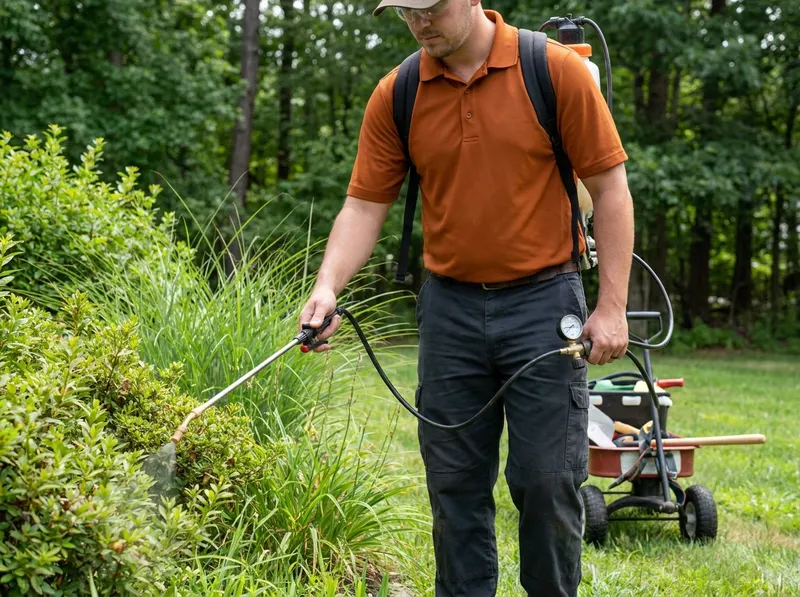
We say what goes down and where. Applications go to foliage undersides, dense shrub interiors, fence lines, ivy, mulch beds and the wooded transition zone; they do not go on open lawn where there is nothing to treat. Blooming plants are skipped or worked around to reduce pollinator exposure, and vegetable gardens are either left untreated or handled per your instruction — tell us where the tomatoes are before we start. Keep people and pets off treated foliage until it dries, generally around 30 minutes to a couple of hours depending on humidity and shade. Water sources get the more durable fix: dumping, tipping, drilling drainage, or treating water that genuinely cannot be drained, like an ornamental pond overflow or a chronically wet swale corner. Finding the water is the part that lasts after the product is gone.
One honest limit: mosquitoes fly, so a treated yard on the Sicklerville Road corridor or in Victoria Manor or Erial still receives arrivals from an untreated neighbor, a drainage ditch, or the woods behind the block. The goal is a strong reduction in the space you use — patio, play set, grill, back door — not a bug-free county. Pricing is built the same way it is explained: lot size, tree and shrub density, feet of wood-line edge, and one-time versus recurring. Call (856) 606-1310 and we'll walk the yard with you, point at the harborage and the water, and confirm the number before anything is applied.
Every job gets a firm, written price after a free on-site visit.
Tell us about your mosquito and tick yard treatment job in Sicklerville and we'll send a clear, written quote — usually the same day.
 Premium Pest Control