Sicklerville's rodent pressure is mostly a geography problem. Homes on the wooded edges — the lots backing onto the Winslow Fish and Wildlife Management Area, the tree lines around New Brooklyn Park and New Brooklyn…
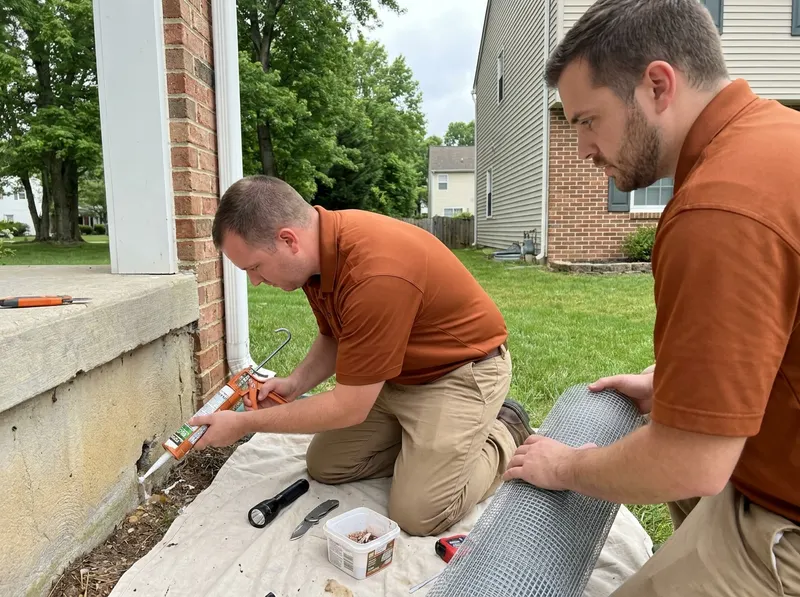
Sicklerville's rodent pressure is mostly a geography problem. Homes on the wooded edges — the lots backing onto the Winslow Fish and Wildlife Management Area, the tree lines around New Brooklyn Park and New Brooklyn Lake, and properties out toward Braddock and Blue Anchor — see white-footed field mice pushing indoors in October and November as the nights drop. The open fields near Cross Keys Airport produce the same fall migration. In the 1980s and '90s developments like Winslow Crossing, Wiltons Corner, Sturbridge Woods and Stonegate, the interior evidence is usually identical from house to house: droppings behind the range, grease marks along the baseboard under the sink, and chewed dog food bags in the garage. The entry point is almost never dramatic. A house mouse can pass through a gap the width of a pencil, and the three we find most often here are the bottom corners of the garage door where the rubber seal has curled, the dryer vent or AC line-set penetration where the original caulk has shrunk, and the sill gap behind vinyl siding on the back of the house.
Older properties along the Sicklerville Road corridor in Old Sicklerville village — and similar-vintage homes in Erial and Victoria Manor — are a different job than newer slab construction. Crawl spaces, block foundations with mortar loss, and framed-in additions give rodents interior travel routes between floors, so the inspection includes the crawl access, rim joist and any abandoned utility chase. In the townhome sections of Cross Keys and Villages at Cross Keys, shared walls change the strategy: mice often enter one unit and travel a whole row, so we document what we find and tell you plainly when a neighboring unit or the HOA needs to be part of the fix. Pretending a shared-wall problem is a single-unit problem wastes your money.
Trapping without sealing is a rental agreement, not a solution. If you only want the current activity knocked down — a short-term rental turnover, a house going on the market, a single mouse after a garage door was left open overnight — a trapping-only program is a reasonable, cheaper choice. If you've had mice two falls in a row, or you're hearing activity in a ceiling or wall void, exclusion is the part that actually ends the cycle, and skipping it means paying for trapping again next season. Rats change the math further: rat work usually means exterior burrow treatment, secured bait stations placed away from where children and pets go, and heavier-gauge sealing materials, because rats gnaw through expanding foam and standard caulk. We use steel wool packing, hardware cloth and mortar patching in gnaw-prone spots for that reason.
On safety and re-entry, we tell you the specifics rather than the word "safe." Interior work in a Sicklerville home is trap-based wherever possible, not broadcast product. Any rodenticide used is placed in locked, tamper-resistant stations outdoors or in inaccessible voids, never loose in a pantry, basement or kids' bedroom. You'll be told which rooms to keep pets out of, for how long, and what to expect for odor — before we start, not after. Pricing is set by four things: pest (mouse vs. rat), home size, severity, and how many entry points need sealing. Nothing gets added to the invoice that wasn't shown to you during the walkthrough. Find the entry. Seal it. Stay clear.
Every job gets a firm, written price after a free on-site visit.
Tell us about your mouse and rat control with exclusion sealing job in Sicklerville and we'll send a clear, written quote — usually the same day.
 Premium Pest Control