Nest removal is the right call when there is one active colony threatening a specific spot you use — the front door at St. Charles Borromeo-side developments, a back deck, a mailbox post, a child's swing set. A…
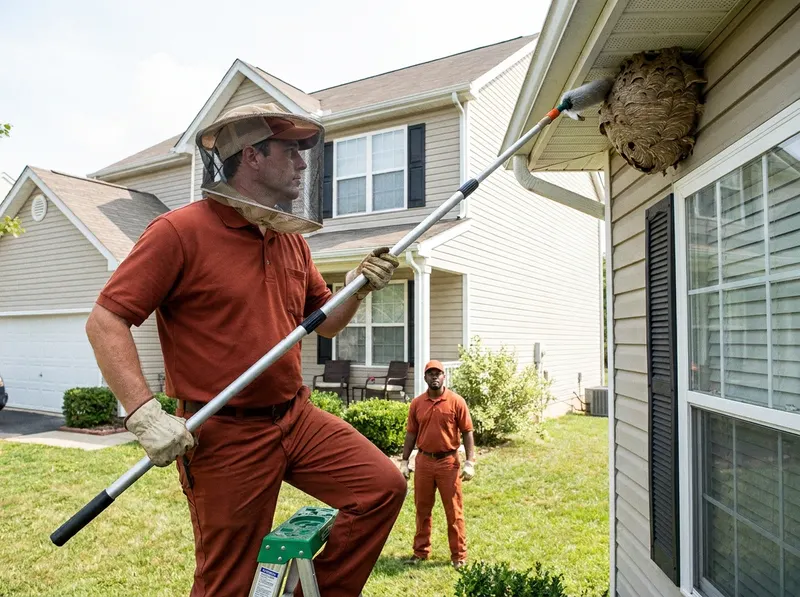
Nest removal is the right call when there is one active colony threatening a specific spot you use — the front door at St. Charles Borromeo-side developments, a back deck, a mailbox post, a child's swing set. A one-time visit ends that colony. A recurring perimeter program is the better fit when your lot backs to woods, which describes a lot of Sicklerville: homes along the edges of the Winslow Fish and Wildlife Management Area, the wooded fringes near New Brooklyn Park and New Brooklyn Lake, and the tree lines behind Sturbridge Woods and Stonegate get re-colonized most summers because the surrounding habitat is producing new queens every year. Removing a nest solves this season; a scheduled exterior service reduces how many nests establish next season. We'll tell you plainly which one your property needs instead of defaulting to the contract.
Where the nest lives changes the price and the method. Exposed paper wasp nests under eaves, grill lids and patio umbrellas in Winslow Crossing and Victoria Manor are usually straightforward. Yellow jackets are the expensive scenario, because they nest out of sight. In older homes along the Sicklerville Road corridor in Old Sicklerville village, and in Braddock and Blue Anchor, colonies commonly move into soffit returns, gaps behind aluminum trim, and voids around chimney flashing — treatment there means dusting the void through the actual flight hole, not spraying the outside of the house. Ground yellow jacket colonies in mulch beds, mole runs and lawn edges are frequent in Wiltons Corner, Erial and the Villages at Cross Keys, and they need the burrow entrance treated after dark. Never seal a wall entry hole before the colony is dead — blocked yellow jackets chew inward toward living space, which is how a yard problem becomes a bedroom problem.
Season matters more with stinging insects than with anything else we treat. Spring nests are small and quiet. By the time Timber Creek Regional and Winslow Township High School are back in session in late August and September, colonies are at peak population and yellow jackets are aggressively scavenging sugars — that is when calls spike across Camden County and the Gloucester County side of the 08081 ZIP in Monroe Township. A late-summer nest is worth removing even in September, because an active colony near a doorway is a stinging risk until the first hard freeze.
On safety and re-entry, here is the practice rather than the word "safe": treatment is applied outdoors at the nest and the void, not broadcast around the yard. Keep people and pets indoors during the treatment and away from the nest area for the rest of that day, keep windows on that wall closed while the void is being treated, and expect stragglers returning to the nest site for 24-48 hours — that is normal and means the colony is collapsing. Ground nests are flagged so nobody mows over them. Honey bees are identified, not treated; if what you have is a honey bee swarm or an established hive, we say so and point you toward relocation. Every visit ends with the same two things: where the nest was, and what gap needs sealing so it isn't reused. Find the entry. Seal it. Stay clear.
Every job gets a firm, written price after a free on-site visit.
Tell us about your wasp, hornet and yellow jacket nest removal job in Sicklerville and we'll send a clear, written quote — usually the same day.
 Premium Pest Control