A liquid barrier fits when termites are active now, or when the structure's construction makes soil treatment the direct route. Most homes in Winslow Crossing, Wiltons Corner, Sturbridge Woods and Stonegate are…
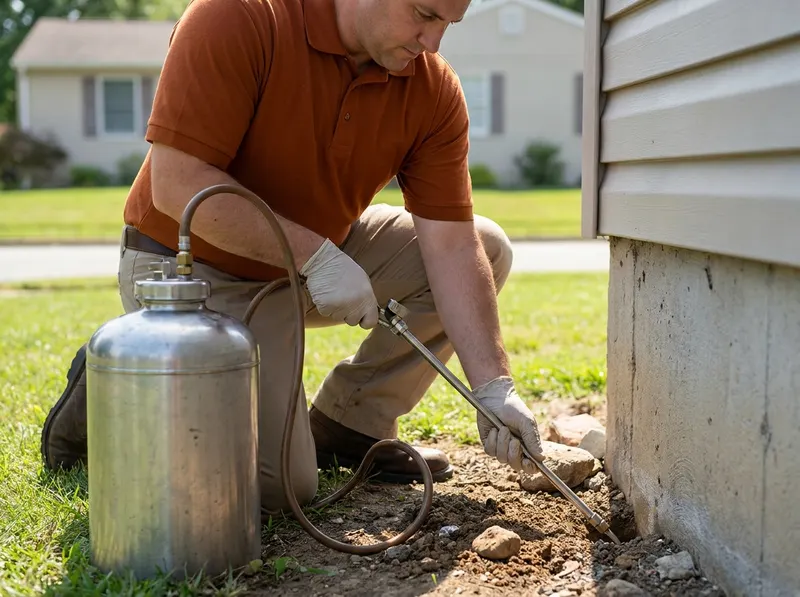
A liquid barrier fits when termites are active now, or when the structure's construction makes soil treatment the direct route. Most homes in Winslow Crossing, Wiltons Corner, Sturbridge Woods and Stonegate are slab-on-grade or shallow-crawl builds from the 1970s through the 1990s, and on those the pressure point is predictable: the expansion joint where the slab meets the block, the garage door track, and the bath trap. Termites travel through soil, so the treatment goes into soil — a trench roughly six inches wide against the foundation, backfilled with treated soil, plus small holes drilled through concrete aprons, front stoops and garage slabs where a trench cannot reach. Holes are patched with cement when we finish. Nothing is broadcast across your living space; the termiticide belongs in the ground and at the base of the walls, and we tell you plainly which rooms are affected and when the area is clear to walk.
The alternative is a monitored bait system, and it is the better call in specific situations. Trenching near a private well head, a shallow irrigation line, or heavy mature root mass under a hardscaped patio is a bad idea, and several properties toward Blue Anchor, Braddock and the outer Sicklerville Road corridor sit on well water where we keep a deliberate distance from the wellhead. Baiting is also gentler on a vegetable garden bed pressed against the house — tell us where the tomatoes go and the trench line changes. The trade-off is speed and structure: liquid establishes a treated soil zone immediately and is measured in linear feet of foundation, while bait works through colony consumption over weeks to months and requires ongoing station checks. Homes with a live spring swarm and visible mud tubes usually want the liquid; homes with no active evidence and difficult access often do better on monitoring.
Local ground conditions matter here more than most of South Jersey. Sicklerville sits on sandy, fast-draining Pine Barrens soil, which means a trench holds its shape and termiticide moves down and out cleanly — but it also means downspout water and irrigation carry away from the wall fast, and a homeowner rarely sees the standing moisture that would tip them off. What we look for instead is contact: mulch mounded over the siding line in Victoria Manor and Erial front beds, landscape timbers set directly against block, fence posts and deck footings buried in soil, and the pine stumps and buried slash common on lots that back to wooded edges near New Brooklyn Park, New Brooklyn Lake and the Winslow Fish and Wildlife Management Area. Those stumps are colonies waiting for a food bridge. Every liquid barrier we quote includes the exclusion notes — what to pull back, regrade or remove — because a treated zone breached by a woodpile against the wall is a treated zone with a door in it.
Townhomes and attached units at Cross Keys and the Villages at Cross Keys need one extra conversation. A shared foundation wall means a barrier on your side only protects your side, and the honest answer is that end units and interior units price differently based on treatable linear footage. We measure it in front of you. In Old Sicklerville village, the older block-foundation and crawl-space homes along the Sicklerville Road corridor tend to hide the real damage in the sill plate and the rim joist above it, so the inspection includes probing accessible framing rather than just walking the perimeter. If a lender, buyer or attorney needs a formal wood-destroying insect report for a settlement, say so when you call so we can confirm exactly what form and scope is required before scheduling. Pricing is set by pest, perimeter length, foundation type, how much concrete needs drilling and severity — no hidden call-for-pricing wall.
Every job gets a firm, written price after a free on-site visit.
Tell us about your termite inspection and liquid barrier treatment job in Sicklerville and we'll send a clear, written quote — usually the same day.
 Premium Pest Control